Videodrone is a weekly feature looking at music videos from the last half century.
Mr. Roboto (1983)
What is a rock opera? It's essentially an album that is tied together by a concept or theme, using characters within the lyrics throughout as a storytelling device.
The concept of the rock opera has been around since the early '60s, when a young Frank Zappa mentioned in an interview that he was working on something called I Was a Teenage Malt Shop. He abandoned the project in 1964 after some of the songs from it were rejected by a record company. But a few years later, the British psychedelic act Nirvana (yes, and they later sued the Seattle band over the name and settled out of court) and the Pretty Things released albums that were considered among the original rock operas.
Then in 1969 came the Who's Tommy, which was the first album billed as a rock opera (and later was made into an actual opera, an orchestral piece, a movie and a Broadway musical). Pete Townshend had previewed what he was working on with the masterful, nine-minute mini-opera "A Quick One, While He's Away" on the 1966 album A Quick One.
Many other examples followed. Andrew Lloyd Webber and Tim Rice released Jesus Christ Superstar as an album in 1970 and then a hugely successful musical the following year. Indeed, on the original album, Deep Purple singer Ian Gillan played Jesus. Other big-name albums that can be considered rock operas include David Bowie's The Rise and Fall of Ziggy Stardust and the Spiders from Mars, Meat Loaf's Bat Out of Hell and Pink Floyd's The Wall.
By 1983, the hard rock act Styx was probably an unlikely candidate to release a rock opera. Although the group's name and early sound leaned a little towards prog rock, by the late '70s Styx had discovered success with a combination of ballads and more meat-and-potatoes rock fare. The Chicago band gradually built their following with hits like "Come Sail Away," "Renegade," "Babe" and "Blue Collar Man (Long Nights)." Singer-keyboardist Dennis DeYoung provided the more melodic hits while guitarist-vocalist Tommy Shaw sang lead on more of the rockers.
Styx reached its pinnacle in 1981 with the release of Paradise Theater, a concept album about a historic Chicago theater that was built in the 1920s and closed 30 years later. The album reached #1 on the Billboard 200 chart behind hits like "The Best of Times" and "Too Much Time on My Hands." It was also one of the first records I ever bought, and I enjoyed it immensely as a young music fan.
The band's next album, 1983's Kilroy Was Here, was their attempt at a rock opera. DeYoung came up with the concept in response to religious and other anti-rock groups that had begun protesting rock music as demonic and immoral (this was a few years before the infamous Parents Music Resource Center made headlines thanks to Tipper Gore). Styx themselves had been targeted by such groups for allegedly including backwards messages on the song "Snowblind," something the band has denied.
The Kilroy Was Here story is set in a future where a fascist government has teamed up with a group called the Majority for Musical Morality to outlaw rock music. DeYoung plays the protagonist Robert Orin Charles Kilroy (ROCK, get it? Very subtle, Dennis), who has been jailed by MMM leader Everett Righteous (played by Styx guitarist James Young). Meanwhile, Shaw plays Jonathan Chance, a young musician attempting to bring rock music back.
The lead single and video is "Mr. Roboto," a synth-pop ditty that was very unlike anything the band had previously released and became very polarizing for the group's fans. I remember hearing it and disliking it immediately, but the song with its refrain of "Domo arigoto, Mr. Roboto" is extremely catchy and tends to stick in your brain regardless of whether you want it to.
In the video (directed by Brian Gibson, who also directed Poltergeist II, What's Love Got to Do With It? and Still Crazy), the robot prison guards (aka "robotos") that oversee Kilroy and the other prisoners were designed by Stan Winston, who would later find fame through his work in movies like The Terminator, Aliens, Iron Man and Jurassic Park. Unfortunately, the design of the mask features a pretty stereotypical "Asian face" that aligns with the theme of Japanese industrialization stealing away American manufacturing jobs that popped up in a lot of '80s media.
And the lyrics underline that: "You're wondering who I am (secret secret, I've got a secret)/Machine or mannequin? (secret secret, I've got a secret)/With parts made in Japan (secret secret, I've got a secret)/I am thee modern man."
The song and album also highlight man's struggle with technology, which obviously in 1983 was nowhere near what it is now, where the robots are literally taking over with the help of big business.
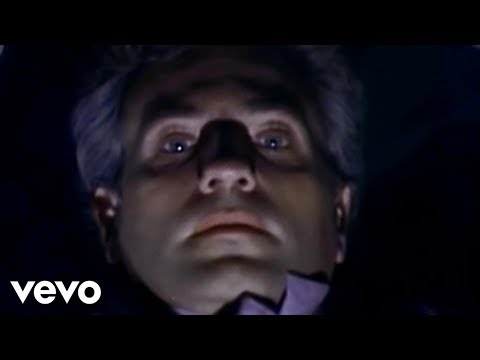
The video begins with Shaw walking into a rock museum to meet Kilroy when he sees a robot approaching. It then morphs into five robots that start dancing (choreographed by Kenny Ortega, who later directed Dirty Dancing and choreographed the infamous Billy Squier video "Rock Me Tonite"). Scenes of DeYoung performing the song live with Styx are intercut with scenes of the robots and Kilroy, who awakes to find the robots experimenting on him and escapes. He then unmasks himself, revealing that Mr. Roboto is indeed Kilroy.
Regardless of its polarizing nature, "Mr. Roboto" was a hit, reaching #3 on the Billboard Hot 100. But the project would lead to the eventual breakup of the band. DeYoung envisioned Kilroy Was Here as an album and a stage show, which opened with a 10-minute short film directed by Gibson (see below; scenes from the film pop up in the "Roboto" video). The film (featuring guest appearances by Robert Romanus--Damone from Fast Times at Ridgemont High--and Michael Winslow, the vocal sound effects wizard who became famous in the Police Academy movies, playing an animatronic Jimi Hendrix) provided the back story, according to DeYoung's description of the short film on YouTube.
"This transitioned into live action with me, as Kilroy, telling Tommy, as Jonathan Chance, the story of the event at a rock concert that led to his incarceration. The actual Styx concert was part of the rock opera, essentially a flashback in Kilroy's story."
The Styx episode of Behind the Music detailed how the early part of the Kilroy tour was a financial disaster, although later arenas performed better. The album sold over 1 million copies and reached #3 on the Billboard album chart, but compared to previous releases, it was a commercial failure. The tour was expensive to put on because of the theatrical elements and it highlighted the creative differences between DeYoung and Shaw and Young. The live performance of Kilroy was released in 1984 on a live album called Caught in the Act, which was also released on VHS (and later DVD). But by the time Caught in the Act was released, Styx had split up.
DeYoung and Shaw both released solo albums in the '80s to varying degrees of success. When Styx reunited in 1990, Shaw was not part of it because of his involvement in AOR "supergroup" Damn Yankees (which featured Ted Nugent and Jack Blades of Night Ranger). The new Styx lineup released Edge of the Century, which scored two top 40 hits and toured, but the band was dropped in 1992 after their label A&M was acquired by Polygram.
The band reunited again in the late '90s and released a new album in 1999, but DeYoung was unable to tour because of illness and was replaced by Lawrence Gowan. That version of the band, led by Shaw and Young, has continued to record and tour since then, while DeYoung has released music and toured on his own.
As for "Mr. Roboto," the DeYoung-less Styx didn't perform the song live for 35 years until Shaw saw a hard rock version performed by the band the Protomen. He liked their arrangement and the current Styx version echoes that. The song remains a pop culture touchstone, showing up in a popular Volkswagen commercial starring a pre-Arrested Development Tony Hale (see below) and being covered on Glee. At the old Webnoize offices, we used to watch it ironically (this was in the pre-YouTube days). Now? I watch it every so often on YouTube.
While it may have broken up an AOR powerhouse, "Mr. Roboto" has transcended into pop culture nostalgia, for better or worse.

No comments:
Post a Comment